

The Graphwise Knowledge Hub
Welcome to the Graphwise Knowledge Hub - your space for exploring products, topics and offering related to semantic technologies, artificial intelligence and knowledge graphs.In this initial implementation, designed to enable Graphwisers to find resources quickly and be able to do our job more effectively, the hub includes marketing collaterals, webpages, GraphDB and Poolparty documentation. It also features the version 0.1 of the Graphwise Knowledge Hub Taxonomy which incorporates big parts of the Ontotext and SWC taxonomies for the purposes of automated tagging.
How to Use The Graphwise Knowledge Hub?
Built using Graphwise’s own semantic tools and powered by the Graphwise Knowledge Graph, the Hub is designed to: Streamline knowledge discovery Reduce time spent searching for relevant content Promote content reuse Enable meaningful engagement with enterprise knowledge assets
Semantic Retrieval-Augmented Generation (GraphRAG)
In the GraphRAG - you will be able to “talk” to the documentation in natural language.
You can use it to ask questions and receive contextual, LLM-generated answers about Graphwise, GraphDB and Poolparty documentation.
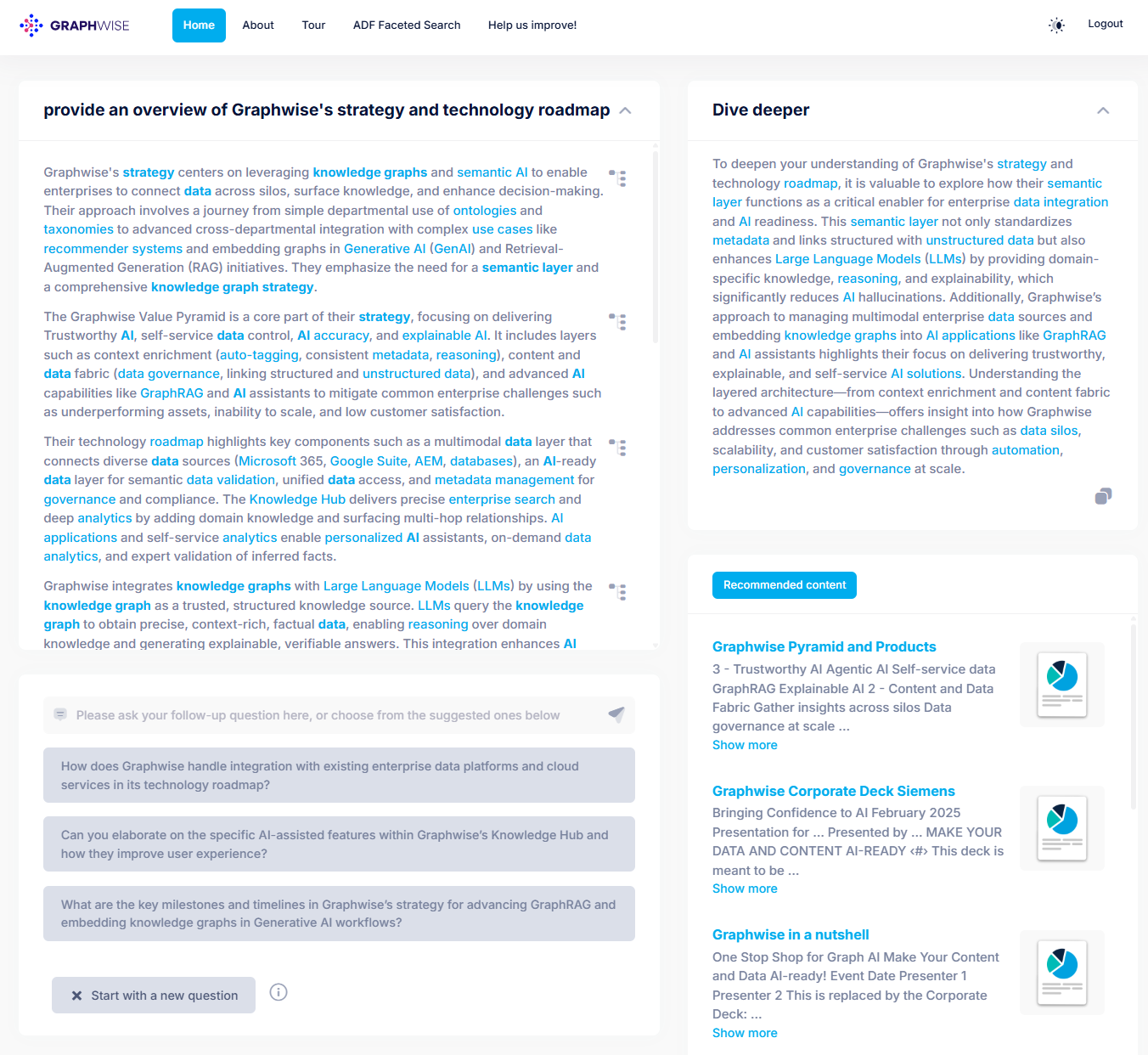
In the answers section, you will also find:
- A Dive Deeper panel for expanded context
- A Copy icon to easily copy
- The last question (if multiple)
- The answer
- The “Dive deeper” content
- The Recommended content references
What To Expect From Graphwise Knowledge Hub in the Future?
The Graphwise Knowledge Hub will be refined and expanded iteratively to serve internal and external Graphwise stakeholders to quickly find what they need - an answer, a piece of content, a set of relationships.
In Graphwise Knowledge Hub 1.1 (expected September 2025) you will see:
- Improved Data Modeling: Establish relationships within the data to strengthen our semantic RAG and expand content coverage.
- Unified Interface: We plan to combine search and facets for a more seamless user experience.
- UI Enhancements: We’re currently in the process of hiring a front-end developer to help improve the system’s usability.
- Enriching the hub with more content: information about demonstrators, training materials, videos about products, customers etc.
How To Help Graphwise Knowledge Hub Serve You Better?
Your feedback is crucial in shaping the future of this system. Please share your feedback, thoughts and suggestions via our dedicated Helpdesk.